

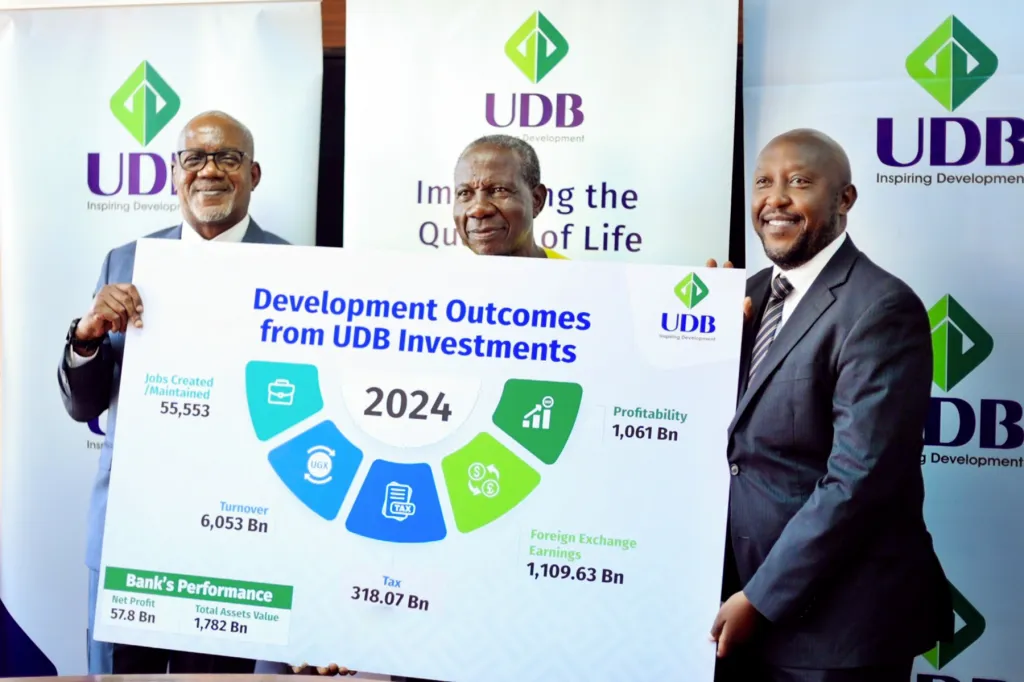
- The Bank disbursed UGX 389 billion in 2024, growing its total assets by 7% to reach UGX 1.78 trillion
- Net loans and advances increased by 9% to UGX 1.53 trillion
- A total of 434 Bank-supported enterprises created and maintained a total of 55,553 jobs, a rise of 7.2%
Kampala, 18th June 2025 – Uganda Development Bank Ltd (UDB), the country’s national Development Finance Institution, has today announced its 2024 performance, highlighting a significant development impact for the country alongside sustained institutional growth.

The results, released during the Annual General Meeting held at the Ministry of Finance, Planning, and Economic Development in Kampala, reflect the Bank’s commitment to fostering economic growth, supporting community development, and delivering sustainable value for stakeholders.
In 2024, the Bank recorded a post-tax (net) profit of UGX 57.8 billion, marking a 16% increase from UGX 49.8 billion in 2023. This growth was driven by the continued strategic investments in interest-earning assets and a steadfast focus on cost prudence and efficiency.
Growth
In her speech, the Bank’s Managing Director, Dr. Patricia Ojangole, discussed UDB’s continued growth and profitability, which are driven by the Bank’s transformation and solid investment in development projects country-wide. Dr. Ojangole confirmed that during the reporting year, UDB’s total assets grew by 7%, reaching UGX 1.78 trillion, up from UGX 1.67 trillion in 2023. This growth was primarily supported by additional capital injections from the Government of Uganda and the accumulation of retained earnings.
The loan portfolio also expanded, with net loans and advances increasing by 9% from UGX 1.47 trillion to UGX 1.53 trillion, reflecting the Bank’s continued commitment to financing impactful development initiatives.
“Through 2024, UDB remained a committed partner in advancing the Government’s economic development agenda, providing targeted financial support to qualifying enterprises and enabling productive investments across priority growth sectors. UDB has made strides in facilitating private sector growth across many dimensions. The Bank has made investments in boosting agriculture and manufacturing, , whilst also unlocking and improving opportunities in the services sector,” Ojangole said on Wednesday.

To support the growth in assets, the Bank strategically reinvested UGX 437 billion collected as loan repayments, alongside UGX 80.7 billion in additional capital contributions from the Government of Uganda; this capital injection significantly strengthened the Bank’s capital base, raising cumulative capitalization from UGX 1.32 trillion to UGX 1.46 trillion, and thereby enhancing the Bank’s capacity to deliver on its development mandate.
Stimulating private sector growth
In 2024, the Bank approved UGX 454 billion in new loans to over 170 enterprises across 67 districts nationwide. These investments are projected to deliver a range of development outcomes – including the creation of 17,832 new jobs, UGX 9.7 trillion in additional output, UGX 1.8 trillion in foreign exchange earnings, UGX 1.7 trillion in profits, and UGX 455 billion in tax contributions to the Government.
During the reporting year, the Bank also disbursed UGX 388 billion in new funding to projects nationwide. As of 2024, the Bank supported 770 active projects spanning 103 districts.
UDB’s Managing Director said, “The industrial sector continued to dominate the Bank’s portfolio, accounting for 50% of UDB’s total investments. Of the UGX 822 billion allocated to industrial activities, 46.8% is directed toward agro-industrialization, 50% toward manufacturing, and 3.2% toward mineral-based industries—reflecting the Bank’s strategic focus on value addition and industrial transformation.”
Additionally, the Bank implemented various institutional initiatives to expand its support to various vital sectors and address systemic growth constraints in the economy, including the following:
- Under the Business Accelerator for successful entrepreneurs (BASE), which bridges the gaps between SMEs and access to finance, BASE handles SMEs’ advisory and capacity building, focusing on youth and women. In 2024, the Bank trained 450 entities across the country. The Bank also operationalized an incubation service to support early-stage businesses in formalizing and strengthening their operations. An inaugural cohort of 71 businesses were incubated during the year.
- Through its Project Preparation offering, UDB addresses technical and financial bottlenecks that often hinder the progression of viable and impactful project ideas, particularly those requiring substantial early-stage investment and technical capacity. This initiative plays a catalytic role in transforming high-potential concepts into bankable projects by providing the necessary support for their maturation. In addition to de-risking early-stage ventures, Project Preparation also facilitates the development of targeted funding initiatives that enhance access to the Bank’s financial products and services. The Bank committed UGX 5.1 billion toward preparing various projects and initiatives. Notable among these are efforts in the agriculture sector, including research to support the local development of high-yielding and high oil-content sunflower seed varieties.
- The Bank also implemented the Hybrid electricity connections program, which has benefitted over 42,000 households and small businesses, and the Ugandan Contractors funding initiative aimed at providing the much-needed affordable capital for local contractors.

Creating a Sustainable Impact for Ugandans
Employment
In 2024, the Bank-supported enterprises created and maintained a total of 55,553 jobs, a rise of 7.2% (3,712 jobs) compared to 51,841 jobs in 2023. The rise was attributed to the increased number of funded businesses, following increased funding and economic activity.
Of these jobs, 59.9% were filled by youth and upto 31.3% by women.
Economic impact
The annual output of enterprises financed by the Bank increased by 3.2% yearly, rising from UGX 5.86 trillion to UGX 6.05 trillion in 2024. This performance highlights the Bank’s catalytic role in accelerating industrialization and driving broad-based economic growth.
Similarly, the tax contribution of these businesses improved to UGX316 billion from UGX236 billion in 2023.
In 2024, UDB-supported enterprises posted over UGX1 trillion in profitability, higher than UGX 869 Billion reported in 2023.
UDB-supported enterprises realized the USD equivalent of UGX1.1 trillion in forex, a 17% increase in forex earnings compared to an equivalent of UGX953. Bn earned in 2023. In 2024, the sectoral analysis of foreign exchange earnings from UDB-supported enterprises, revealed significant contributions from key sectors, notably, the agro-processing and manufacturing sectors.
Efficient Operations
The Bank continues to focus on delivering results using lean and efficient operations. In 2024, the cost-to-income ratio (excluding impairment) remained stable at 31%, consistent with the previous year.
Over the past five years, the return on assets has continued on a positive upward trajectory, rising to 3.26% in 2024 from 3.13% in 2023. Return on equity also marginally improved, increasing from 3.82% to 3.89%, underscoring the Bank’s ongoing efforts to generate value for its shareholders.
“As the Bank positions itself for greater impact, it will focus on maximising resource efficiency across financial, human, technological, and institutional capacities. Additionally, the Bank will actively explore innovative and diversified funding avenues to scale its interventions and amplify development outcomes, whilst assuring long-term value creation for its stakeholders,” said the Managing Director.
Recognition and Awards
In 2024, UDB received both local and international recognition for its accomplishments in enhancing its operations, governance, and several other parameters.
- The Bank was named the 2024 Regional Bank of the Year – East Africa at the prestigious African Banker Awards, in acknowledgement of the sustained institutional performance and resilient leadership, delivering profitable, impact-driven lending while advancing green and sustainability priorities, even amid external shocks.
- For the fourth consecutive year, the Bank and its Managing Director emerged as the Sustainability Leader of the Year at the Karlsruhe Sustainability Awards in Germany. This recognition recognizes the MD’s exceptional leadership in driving UDBL’s business performance through creating social, economic, and environmental values and globally advancing sustainable finance.
- Credit Ratings: UDB secured a ‘AA+ (Uga)’ National Long-term Rating with a Stable Outlook. This designation, assigned by Fitch Ratings, a globally renowned credit rating agency, was accompanied by a ‘B+’ Long-Term Issuer Default Rating (IDR) with a negative outlook – the same pegged to Uganda’s Sovereign rating, reflecting the Bank’s ownership by the Government.
- UDB, alongside five other Development Finance Institutions (DFIs) in Africa out of more than 80 participants, earned an AA rating from the Association of African Development Finance Institutions (AADFI).
This recognition reinforces UDB’s standing as one of the continent’s best-performing DFIs. It underlines the Bank’s commitment to excellence in meeting stringent prudential standards, particularly in governance, operational efficiency, and overall institutional performance.
- The Bank received Level 5 certification under the Sustainability Standards and Certification Initiative (SSCI) Version 2, the highest level of sustainability excellence in the certification process – a testament to UDB’s commitment to consciously advancing holistic sustainability in its operations.
The Minister of Finance, Planning, and Economic Development, Hon. Matia Kasaija, lauded the Bank for its exceptional contribution towards the realization of the Country’s National Development Plan and Vision 2024.
“I am pleased that UDB’s 2024 interventions are aligned with the strategic objectives outlined in the country’s national development plan. An efficient national development financing institution, such as UDB, is critical in realizing our development goals as a country. Through UDB, the government continues to support private businesses by providing long-term and patient capital,” said Minister Kasaija.

In his remarks, the Chairman of the Board of Directors of Uganda Development Bank (UDB), Mr. Geoffrey Kihuguru, reiterated the Bank’s commitment to ensuring its long-term sustainability by exercising prudent stewardship in asset creation and deployment, and in maintaining operational efficiency.
END