

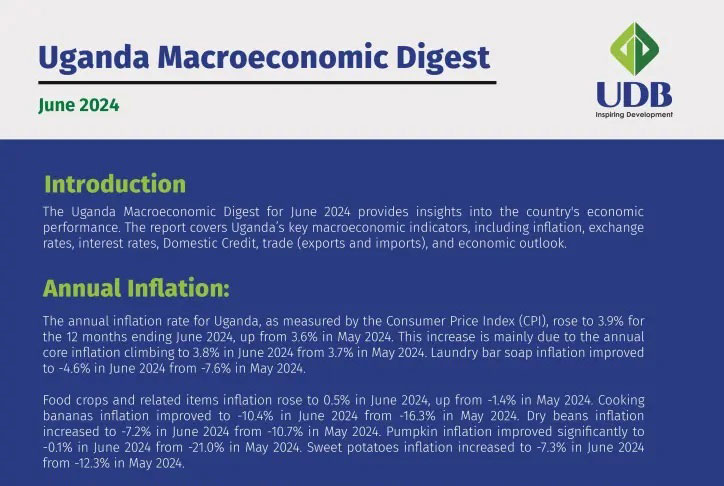
Rising inflation in Uganda, with annual rates increasing to 3.9%, signals potential cost pressures on households and businesses, particularly due to higher energy and utility costs. Optimism in the business environment, reflected by positive Business Tendency Index (BTI), and Purchasing Managers’ Index (PMI) indices, suggests economic resilience. However, trade deficits and rising interest rates may pose challenges to sustainable growth.

Inflation Trends: Uganda’s annual inflation rose to 3.9% in June 2024 from 3.6% in May, driven by increased core inflation. Food crops, energy, fuel, and utilities also saw significant inflationary pressures.
Business Perceptions and Economic Activity: Economic activity in Uganda remained robust in June 2024, with positive trends in the Composite Index of Economic Activity (CIEA), Purchasing Managers’ Index (PMI), and Business Tendency Index (BTI). The BTI increased to 58.57, and the PMI, though slightly lower, remained above the 50-mark at 51.9, reflecting continued improvements in business conditions amid rising demand and output.

Interest Rate Movements: In June 2024, the Bank of Uganda maintained the Central Bank Rate (CBR) at 10.25%. Shilling-denominated lending rates rose to 18.85% in May 2024 from 17.74% in April 2024, reflecting tighter monetary policy and increased risk aversion among creditors.

Domestic Credit: In May 2024, domestic credit increased by 4.4% to UGX43.81 trillion, driven by a significant rise in net credit to the government, which surged by 10.0%, while private sector credit showed a modest increase of 0.4%.

Trade Balance and Terms of Trade: Uganda’s trade deficit increased by 17% to $362.8 million in May 2024 from $309.0 million in April, due to a 32% surge in imports. However, the terms of trade index fell by 3%, reflecting less favorable export values relative to imports

Economic Outlook: Uganda’s economy is projected to grow by 6.0%-6.5% for FY2024/25, supported by higher investments in the extractive industry and government intervention programs. Risks include global uncertainties, potential shilling depreciation, and tighter domestic financing conditions.

